
What is a 5×5 Strength Program?
A 5×5 program is one where lifters perform five sets of 5 reps with loads at 80 to 85% of their one-repetition maximum (1RM). Such programs are typically based on linear progression and designed for strength gains. Despite its simplicity, 5×5 is an effective method for improving core lifts (bench press, squat, and deadlift).
Madcow 5×5 is an intermediate program based on the original 5×5 plan developed by Bill Starr––a pioneer in the strength training world. Bill’s methods and approaches are the base of countless modern training programs, including Madcow’s version.
Bill Starr’s original 5×5 plan consisted of three workouts, each including three movements. For example, trainees would perform power cleans, bench presses, and squats on Monday. Wednesday would feature lighter power cleans, incline presses, and squats. On Friday, trainees would work with moderate weights, performing power cleans, overhead presses, and squats.
Madcow was a member of the EliteFitness forums and developed his version of the 5×5 program for strength and bodybuilding. He wanted the program to be equally suitable for building strength and muscle mass without wasting people’s time on irrelevant exercises.
Despite its original intent, the program gained popularity and is now considered an effective intermediate program for powerlifters. The Madcow program can also work for advanced lifters looking to build strength in the press and deadlift. It’s unclear who Madcow is, but rumors suggest that he was a friend of Glenn Pendlay (yes, the same person who developed the Pendlay row). Glenn and Bill had worked together in the past.
What is the Madcow 5×5 Workout?
The original 5×5 plan by Bill Starr included a limited number of movements, so Madcow took things a step further and tweaked the program to train the entire body more evenly. He kept the original 5×5 structure, added some accessory work, and made changes to prioritize recovery for optimal strength gains.
The primary movements in the program are the squat, bench press, barbell row, overhead press, and deadlift. Madcow has also included specific accessory work in each session. We’ll discuss them more in-depth below.
Accessory lifts are those you perform to accumulate more training volume and support your performance on the main movements (overhead press, squat, etc.). How much weight you use on supplementary exercises matters far less than your progression on the main lifts.
Examples of accessory activities include push-ups, chest flies, leg extensions, leg curls, seated cable rows, lateral raises, and similar exercises.
Trainees can skip accessory work and only do the main lifts, but that would make it harder to do enough sets to build muscle (1). The exercise lifts are necessary for hypertrophy, muscle coordination, and strength, but assistance movements put the finishing touches on all major muscle groups and optimize progression.
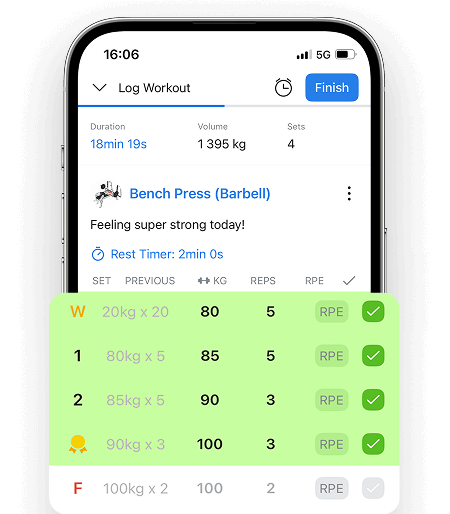
One of the most significant differences is that Madcow’s version uses progressively heavier sets of 5 reps. You begin with a lighter load and gradually progress through the sets, with the last one serving as the top set. We’ll go over what that looks like in practice below.
Weight progression occurs weekly rather than workout to workout, unlike in other 5×5 programs. You follow a linear structure, but progress is slower since you’re no longer a beginner. Increasing the weight from workout to workout can be too much and lead to a breakdown in technique or failure to complete all the repetitions.
Many people draw similarities between Jim Wendler’s 5/3/1 and Madcow’s 5×5 programs, claiming they feel identical in practice. The primary difference is that Jim’s approach is more suited for beginners, whereas Madcow’s version works better for intermediate and advanced trainees.
Workout Breakdown – Madcow 5×5
Here are examples of two Madcow 5×5 workouts:

| Workout 1 | Workout 2 |
| Squat (Barbell) 2×5 Overhead Press (Barbell) 1×5 Deadlift 1×5 | Squat (Barbell) 1×3 Bench Press (Barbell) 1×3 Bent Over Row (Barbell) 1×3 |
Here are a few notes about the above set and rep recommendations:
- 1×5 means doing a final heavy set that pushes you to your limits after increasing the load steadily from the first to the fourth set
- 2×5 means doing two heavy sets close to your limits after increasing the weight on the bar between sets one and three
- 1×3 means gradually increasing the load from sets one to four and doing a heavy set of three reps to finish off
The workout structure is nothing special. You should start by warming up and proceed to your working sets (2). Begin with lighter and more manageable loads, gradually increasing the weight on the bar with each set. Depending on the specific exercise (e.g., 1×5, 2×5, etc.), your last set or two should be close to your limits. The final of the three workouts, which occurs on Friday for most trainees, includes a lighter ‘back-off’ set of 8 reps for all main lifts.
Recovering between sets for at least 2.5 minutes is crucial for maintaining your performance and getting stronger (3). There is no point in rushing through your workouts because it would impair your performance and increase the risk of technique breakdown.
Main Lifts
Squat (Barbell)
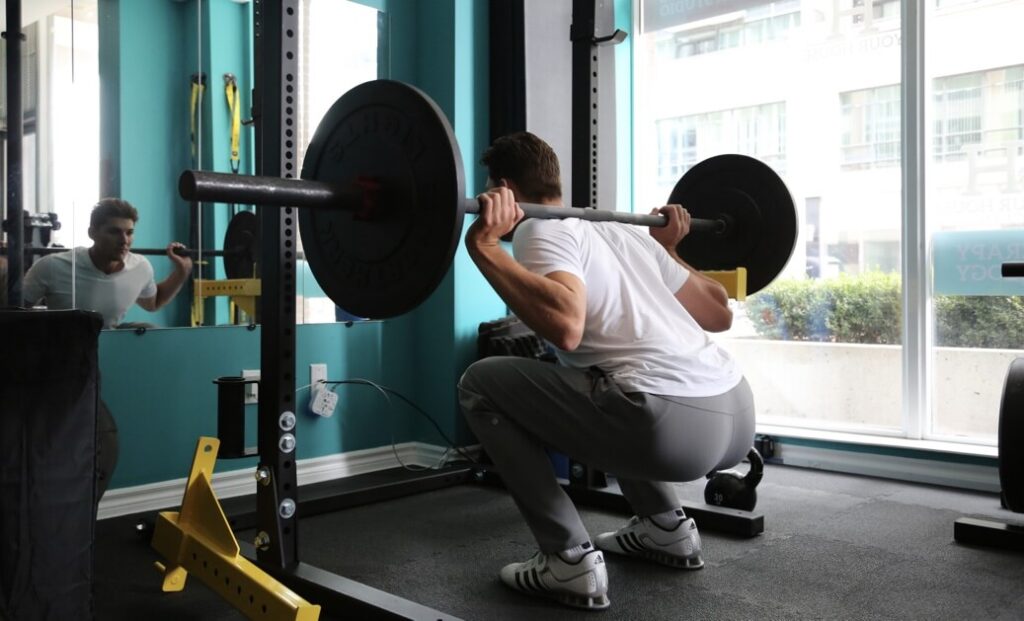
The barbell back squat is a full-body movement that primarily targets the quadriceps while also developing the glutes, back, midsection, and shoulders (4).
Bench Press (Barbell)
The barbell bench press is an upper body exercise that develops pushing strength and builds the pectoralis major (chest), deltoids (shoulders), triceps, serratus anterior, and midsection (5).
Bent Over Row (Barbell)
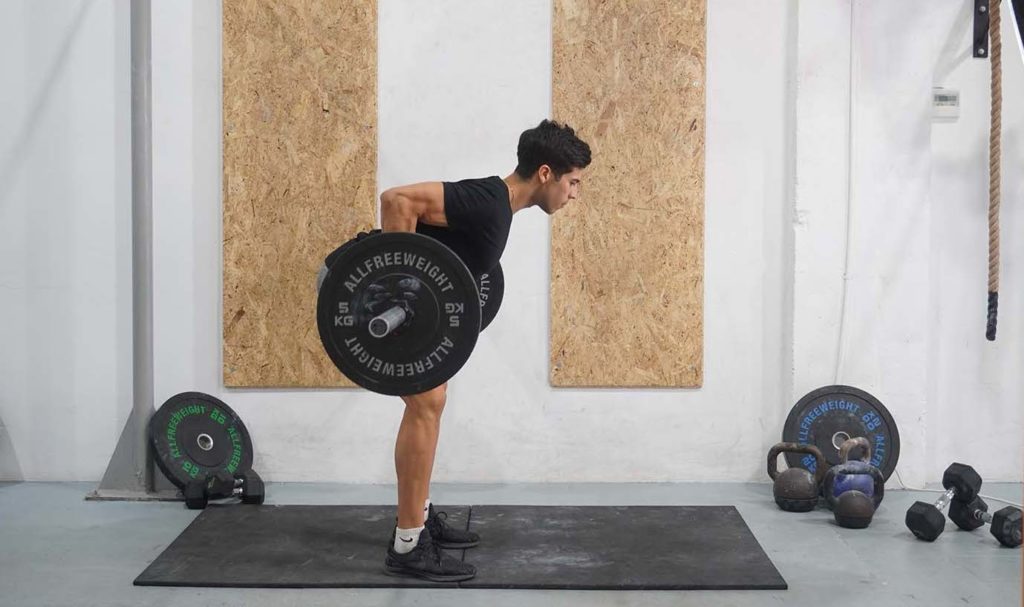
The barbell row is an excellent compound movement that targets and overloads the entire back, biceps, forearms, and midsection (6).
Overhead Press (Barbell)
Standing barbell presses are one of the most challenging compound movements. It primarily develops the shoulders and triceps but also works the entire back, midsection, and glutes, which flex isometrically to provide torso stability (7).
Deadlift
Deadlifts are one of the most popular weight training exercises. The movement strengthens a range of major muscles in the body, improves athletic performance, and reduces the risk of injury (8).
Madcow 5×5 Routine
The following is what the Madcow workout plan looks like with no additional accessory work:
| Monday (Heavy Day) | Wednesday (Light Day) | Friday (Moderate Day) |
| Squat (Barbell) 1 x 5 Bench Press (Barbell) 1 x 5 Bent Over Row (Barbell) 1 x 5 | Squat (Barbell) 2 x 5 Standing Shoulder Press (Barbell) 1 x 5 Deadlift 1 x 5 | Squat (Barbell) 1 x 3 Bench Press (Barbell) 1 x 3 Bent Over Row (Barbell) 1 x 3 |
Schedule
Monday – Full Body
Tuesday – Off
Wednesday – Full Body
Thursday – Off
Friday – Full Body
Saturday – Off
Sunday – Off
Lifters often struggle with determining what load to use during their workouts. Doing so gets easier when you take the time to decide on your starting weights for Madcow 5×5. You must then stick with the prescribed loads, even on days when you feel that you can lift more.
It’s normal for strength to fluctuate because it depends on your sleep, nutrition, excitability, the stress outside the gym, and more.
The Madcow 5×5 calculator helps you determine how much weight to lift. It’s best to start conservatively so you can complete all prescribed repetitions. You can always bump the load slightly if you feel you’ve underestimated your strength.
Another option for determining your starting loads is to use a simple 1RM calculator and start with about 75% of your 1RM. You can also go by feel, given that you should have some idea of what heavy weight you can handle comfortably for five reps.
Madcow 5×5 Progression
Progression is a major part of any strength program, and it’s no different for the Madcow 5×5 workout plan. The objective is to steadily add weight to the bar and stay challenged without grinding reps to complete your sets. Use your best judgment before worrying about the rules.
Your sets and reps will remain the same even after weeks of following the program. The only variable is the bar load, and Madcow’s 5×5 plan follows a linear progression model: you must complete all reps with a given weight before increasing it.
Here is what progression might look like if you did a heavy set of 5 (top set) with 315 lbs on the squat during the week:
Week 1 – Workout 3 (e.g., Friday)
Squat:
Set 1 – 165 lbs for 5 (52.5% of top set)
Set 2 – 205 lbs for 5 (65% of top set)
Set 3 – 245 lbs for 5 (77.5% of top set)
Set 4 – 280-285 lbs for 5 (90% of top set)
Set 5 – 322.5 lbs for 3 (top set; 102.5% of top set)
Back-off set – 245 lbs for 8 (77.5% of top set)
You progress the weight for your top set by 2.5% or 5 lbs. Once you’ve hit your reps across all sets, adjust the values for the next week:
Week 2 – Workout 1 (e.g., Monday)
Squat:
Set 1 – 160 lbs for 5 (50% of top set)
Set 2 – 200 lbs for 5 (62.5% of top set)
Set 3 – 240 lbs for 5 (75% of top set)
Set 4 – 280 lbs for 5 (87.5% of top set)
Set 5 – 320 lbs for 5 (top set; 100%)
Here is what progression might look like over eight weeks. The following only refers to one exercise in the first of the three weekly workouts:
| Reps | Week 1 | Week 2 | Week 3 | Week 4 | Week 5 | Week 6 | Week 7 | Week 8 |
| 5 | 157.5 | 160 | 162.5 | 165 | 167.5 | 170 | 172.5 | 175 |
| 5 | 195 | 200 | 205 | 205 | 210 | 212.5 | 215 | 217.5 |
| 5 | 235 | 240 | 242.5 | 247.5 | 250 | 255 | 257.5 | 262.5 |
| 5 | 275 | 280 | 285 | 287.5 | 292.5 | 297.5 | 302.5 | 307.5 |
| 5 | 315 | 320 | 325 | 330 | 335 | 340 | 345 | 350 |
As your top set loads progress weekly, so does the weight you lift on all other sets, since they are all percentage-based. The standard option is to go from 50% to 100% of your top set weight in 12.5% increments, but you can be more conservative at first.
As discussed above, taking at least 2.5 minutes to recover between sets, especially as you near your top set, is necessary to optimize your performance and progression (3).
Organize and log your workouts using the Hevy app to ensure you are increasing the weight on each set.
Assistance Exercises on Madcow 5×5
Unlike the traditional 5×5 strength program, Madcow’s version includes recommended assistance movements for each workout.
| Workout 1 | Workout 2 | Workout 3 |
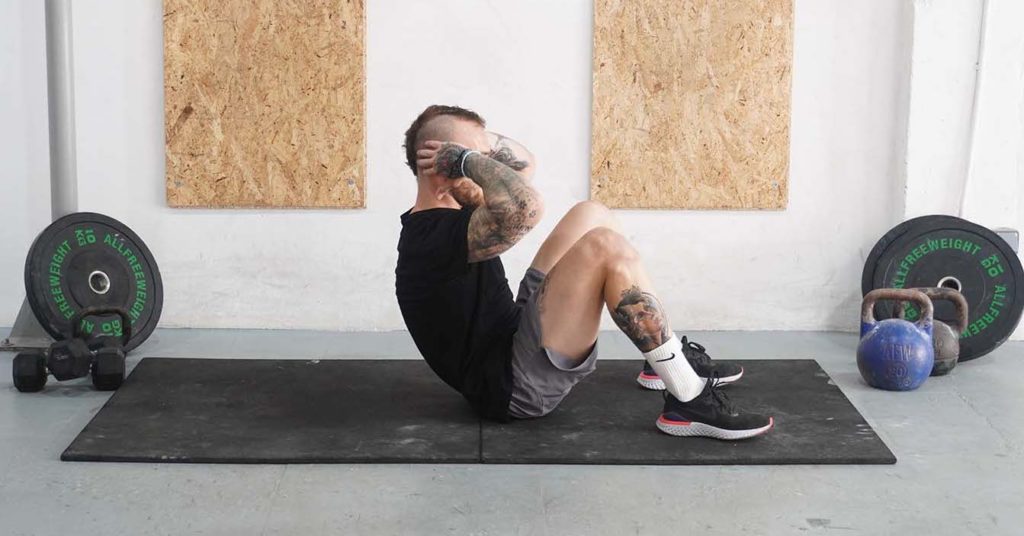
| Back Extension (Weighted Hyperextension) 2 sets of 10 to 12 reps Sit Up (Weighted) 4 sets of 10 to 12 reps | Sit Up 3 sets, max reps Sit Up (Weighted) 4 sets of 10 to 12 reps | Chest Dip (Weighted) 3 sets of 5 to 8 reps Bicep Curl (Barbell) 3 sets of 8 reps Tricep Extension 3 sets of 8 reps |
Here is what the third workout will look like with the assistance exercises included:
Squat (Barbell) – 1×3
Bench Press (Barbell) – 1×3
Bent Over Row (Barbell) – 1×3
Chest Dip (Weighted) – 3 sets of 5 to 8 reps
Bicep Curl (Barbell) – 3 sets of 8 reps
Tricep Extension – 3 sets of 8 reps
As discussed above, your primary focus should be to progress on the core lifts by following the structure we’ve outlined above. Assistance movements support your performance on the core lifts and help you accumulate more sets to build muscle.
You can swap some of the above accessory movements but keep the sets and rep ranges the same. The strength training program is demanding, and adding too many additional exercises can impair your recovery and slow down the progression.
Difference Between the Madcow 5×5 and StrongLifts 5×5
StrongLifts 5×5 is a training program developed by Mehdi, a training enthusiast and coach from Belgium. The training plan is designed for beginners and consists of two workouts (A and B). Trainees must work out three times per week, alternating between the two workouts. One week would include workouts A, B, and A, and the next would consist of sessions B, A, and B.
Madcow and StrongLifts are similar in a few ways
- Both training programs include three weekly workouts, and trainees must recover for at least a day between sessions.
- Both programs use a linear progression: complete all prescribed repetitions before increasing the load for the next session or training week.
- Both routines are based around core lifts: the bench press, squat, deadlift, overhead press, and bent-over row. You must take advantage of heavy weight training to make progress.
At first glance, the two programs seem identical and interchangeable. But, as discussed above, Madcow 5×5 is for intermediate lifters and is a more advanced program. In contrast, StrongLifts 5×5 is great for beginners looking to develop a foundation. Both can be called powerlifting programs, but they also aim to build a fitness foundation and help you gain muscle.
The first notable difference between the two programs is that StrongLifts features load increases from workout to workout. As a result, trainees progress much more quickly.
Another difference is that StrongLifts includes straight sets of 5 reps: you train with the same load from the first to the last set. In contrast, Madcow 5×5 is about gradually working up to a top set, which tends to be more sparing and easier to handle.
The next difference between the two programs is that StrongLifts is based solely on core barbell lifts: squats, deadlifts, bench press, barbell row, and overhead press. Madcow 5×5 includes these movements but also includes assistance exercises.
The creator of StrongLifts suggests switching to Madcow once you’ve built strength with his program. According to Mehdi, the average person should move to Madcow once they reach a 300-pound back squat. You can also switch to Madcow if you feel you cannot progress as quickly on StrongLifts.
Difference Between Madcow 5×5 and Texas Method 5×5
The Texas method and Madcow are intermediate-level programs that feature three weekly workouts. Madcow’s primary purpose is to help trainees build strength and muscle mass, whereas the Texas method is geared toward explosive strength training.
The Texas method was initially meant to be used by Olympic weightlifters and athletes looking to develop their strength. As time went by, more and more powerlifters began adapting the Texas method in one form or another to aid their performance on the big three: the squat, bench press, and deadlift. Mark Rippetoe and Glenn Pendlay played a massive role in popularizing the training approach among strength enthusiasts.
One of the most significant differences between the two programs is that Madcow is a strict training plan, but the Texas method is more of a template you can adjust to fit your needs. Madcow outlines everything down to the specific exercises you should do, how many reps you should perform, and how you should calculate the load for every set. In contrast, the Texas method is more flexible, and each week’s training depends on your previous performance.
The Texas method includes three unique workouts: volume day, light day, and heavy day. Each cycle lasts for two weeks, and the Texas method includes squats, deadlifts, the bench press, overhead presses, power cleans, and back extensions. You squat three times weekly, perform power cleans on Monday, and deadlift on Fridays.
The Texas method has you alternate between the overhead and bench press from session to session. You do the bench twice and the overhead press once in week one, and week two has you overhead press two times and bench press once.
Given that deadlifts are more challenging to recover from, the Texas program has you do them once per week. The rationale is that squats have a good carryover to the deadlift, and doing them three times per week would allow trainees to develop strength effectively.
Both training approaches are similar, especially regarding the exercises, weekly schedule, and workout structure. Madcow might be easier to grasp and apply, whereas the Texas method involves more critical thinking and forces you to make training decisions based on how you respond to each session.
Pros and Cons of the Madcow 5×5 Workout
Pros
Simple to program: A notable benefit of the Madcow workout plan is that it is simple to program. You only have five core lifts and a handful of assistance movements, making it easy to put together the workouts.
Based on effective movements: The squat, bench press, deadlift, barbell row, and overhead press are some of the most effective compound lifts for building muscle and gaining strength.
Gradual progress: Another benefit of the Madcow 5×5 program is its more gradual progression compared to other programs. As a result, trainees don’t feel overwhelmed and can make progress without risking technique breakdown.
Emphasis on recovery: Madcow 5×5 is a program dedicated to intermediate lifters. Because of that, there is a greater emphasis on recovery, and the progression model isn’t as aggressive as beginner programs like StrongLifts.
Cons
Not much variety for assistance exercises: Sit-ups make up a big chunk of the prescribed assistance work, which is odd. The movement can be beneficial, but there is no need to limit yourself to a single exercise. Planks, reverse planks, cable woodchops, and leg raises are some fantastic movements you can add to your strength training.
Progression in the program can be confusing: it takes time to wrap your head around Madcow 5×5 and understand how it works. The program is relatively straightforward, but not everyone understands that the top set is of the most crucial importance and all your sets stem from that value.
Workout 2 can be challenging to complete: Workout 2 includes squats, shoulder presses, and deadlifts. The first two work well in combination, but you might struggle to complete your five sets of deadlifts after squatting.
Importance of Recovery
Recovery is essential to any 5×5 program because it allows you to build muscle and get stronger in response to heavy lifting. Not recovering well would lead to a drop in performance, technique breakdowns, and an increased risk of injury.
One of the best ways to ensure good recovery is to follow the Madcow 5×5 program without adding extra assistance exercises. The five core movements are challenging enough, and adding too many additional activities could impair your recovery and prevent you from attacking each session in a fresh and recovered state.
You must also take care of your life outside the gym: sleep well and eat a balanced diet.
Sleeping for at least seven hours per night is necessary for supporting protein synthesis, muscle repair, and growth (9). Good tactics for improving your sleep include:
- Keep your bedroom dark, quiet, and cool (65 to 70 degrees F; 18 to 21 degrees C)
- Invest some money in a quality mattress and pillow
- Avoid alcoholic drinks within one to two hours of your bedtime
- Avoid caffeine (sodas, energy drinks, coffee, certain teas, etc.) within six to eight hours of going to bed (10)
- Limit screen use within an hour of going to bed
- Have a relaxing routine before bed: read a book, take a bath, stretch, meditate, write in a journal, etc.
Good nutrition is also crucial for making the most of Madcow or any strength program. First, maintain a slight calorie surplus for steady weight gain or eat at maintenance. Madcow isn’t designed to work while dieting for fat loss.
Second, consume enough protein (at least 0.7 grams per pound of body weight) because the nutrient supplies your body with the amino acids it needs to repair muscle and build it up (11).
Final Thoughts
Madcow 5×5 is a training plan designed by an EliteFitness forum user and based on the original program by Bill Starr. Unlike the original 5×5 method, Madcow’s version includes more exercises with the goal of training the entire body in a more balanced way.
Aside from the five core barbell lifts, the program features assistance exercises that support your training performance and allow you to do more work for muscle growth.
It’s unclear who Madcow truly is, but sources speculate that he was friends with Glenn Pendlay, who has worked with Bill Starr.
The Madcow 5×5 workout plan is aimed at intermediate and advanced lifters, which is why it is slightly different from other versions of 5×5. First, progression occurs more slowly than in programs like StrongLifts. Second, you’re not doing straight sets (using the same weight) but are gradually working up to a top set for each movement.
As a whole, Madcow’s training method is simple and useful for getting you strong and muscular. Basing your training around the core barbell lifts is a fantastic way to develop your physical capacity and build all the major muscle groups in your body.