
A 6-day workout split is an approach where you do six weekly training sessions and rest only one day. The high-frequency program offers numerous benefits but also some drawbacks. Read on to learn all about it.
Key Takeaways
- A 6-day split can be effective, but it’s recommended to keep each workout shorter and less intense, at least while getting used to working out daily.
- Some 6-day split options include push/pull/legs, upper/lower, the Arnold split, and a bro split.
- A 6-day split is generally not needed for the average trainee. It’s only a good idea if you can recover well, enjoy working out daily, and are in a calorie surplus for muscle gain.
- A less demanding split, such as a 3- or 4-day one, is more sustainable, easier to recover from, and suited for most people looking to build muscle and lose fat.
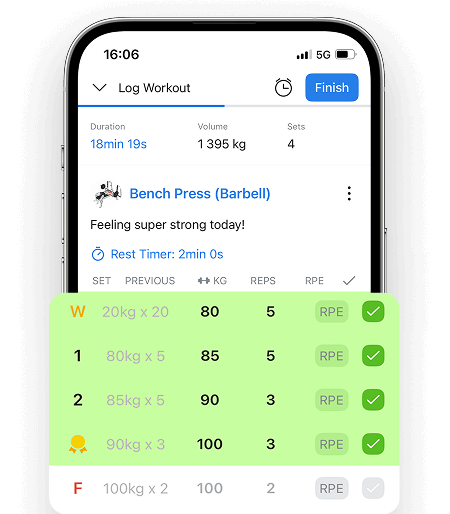
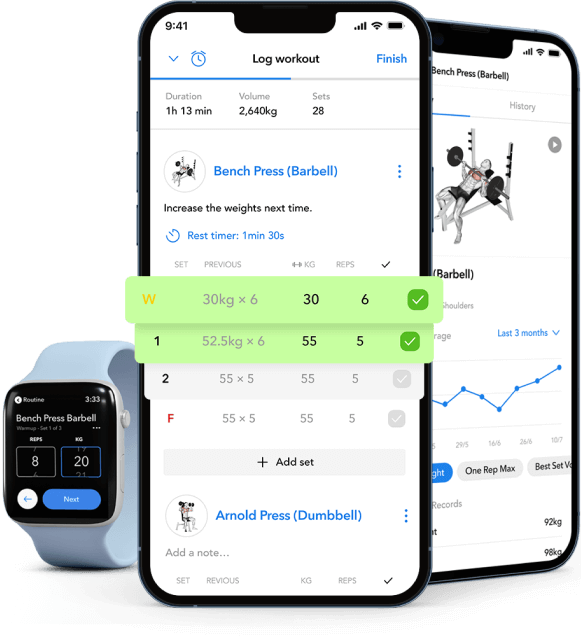
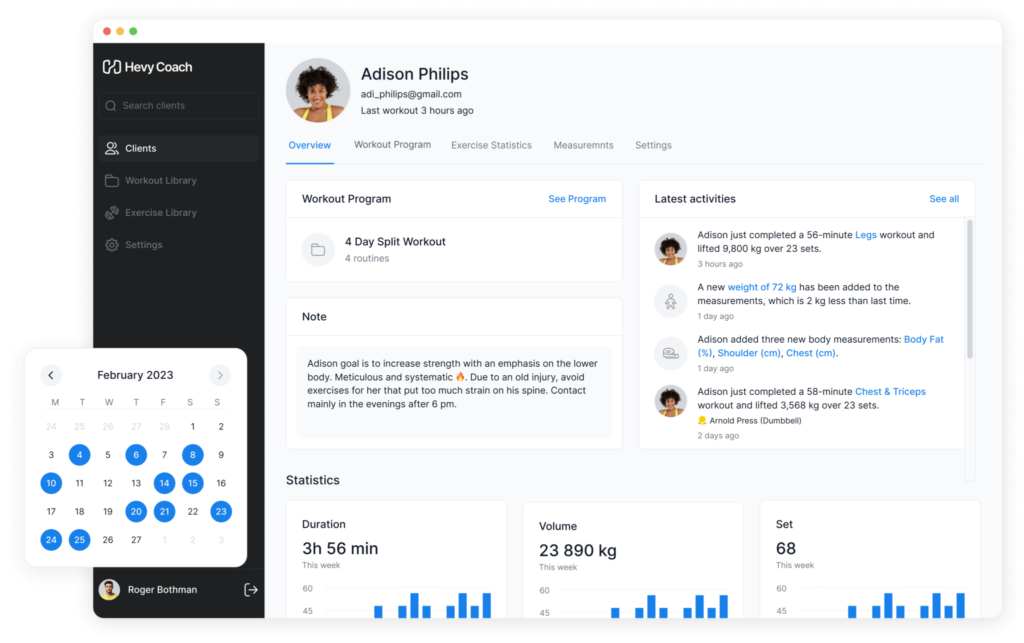
- Use Hevy to store your routines (reusable templates), log workouts with as many details as you want, and track your exercise performance and body composition.
What Are Some 6-Day Workout Split Options?
Some ways to structure a 6-day split include push/pull/legs, upper/lower, bro split, and Arnold split. Let’s break them down below with examples.
6-Day Push/Pull/Legs Split
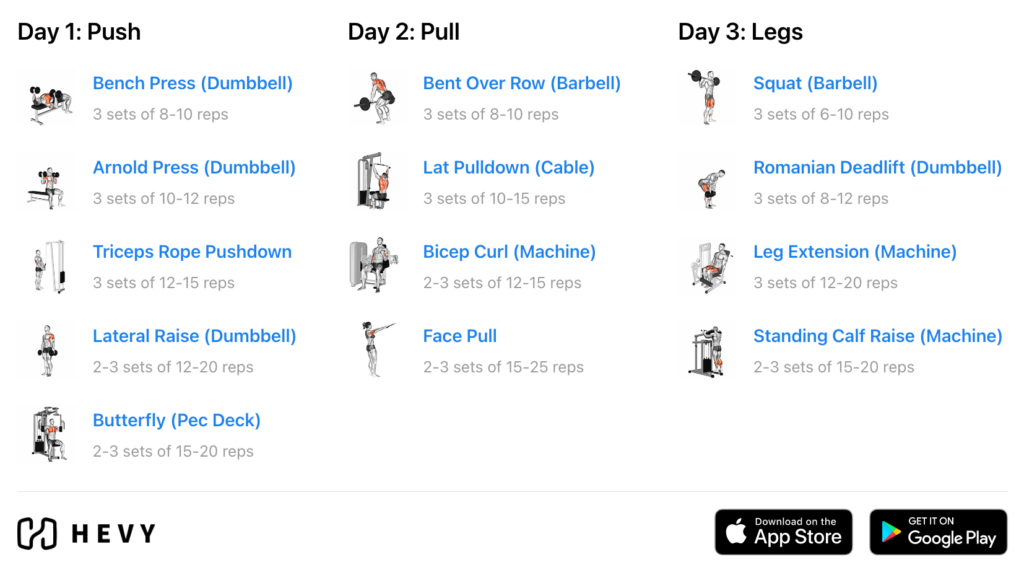
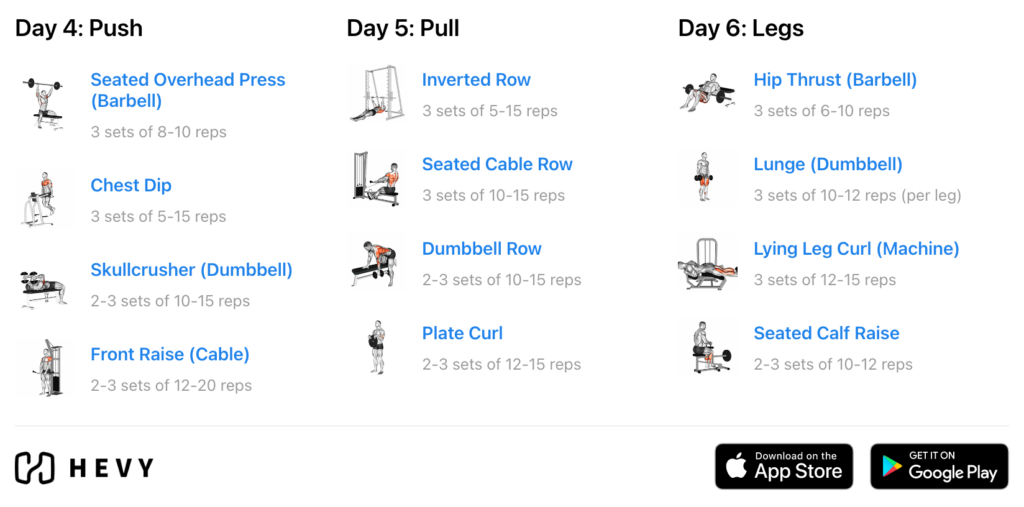
A 6-day push/pull/legs split (also known simply as ‘6-day PPL’) is one in which you do two push, two pull, and two leg workouts over one week. Train your chest, shoulders, and triceps on push sessions; your back and biceps on pull sessions; and all lower-body muscles on legs sessions.
Level: Advanced
| Day 1: Push | Day 2: Pull | Day 3: Legs |
| Bench Press (Dumbbell) 3 sets of 8 to 10 reps Arnold Press (Dumbbell) 3 sets of 10 to 12 reps Triceps Rope Pushdown 3 sets of 12 to 15 reps Lateral Raise (Dumbbell) 2-3 sets of 12 to 20 reps Butterfly (Pec Deck) 2-3 sets of 15 to 20 reps | Bent Over Row (Barbell) 3 sets of 8 to 10 reps Lat Pulldown (Cable) 3 sets of 10 to 15 reps Bicep Curl (Machine) 2-3 sets of 12 to 15 reps Face Pull 2-3 sets of 15 to 25 reps | Squat (Barbell) 3 sets of 6 to 10 reps Romanian Deadlift (Dumbbell) 3 sets of 8 to 12 reps Leg Extension (Machine) 3 sets of 12 to 20 reps Standing Calf Raise (Machine) 2-3 sets of 15 to 20 reps |
| Day 4: Push | Day 5: Pull | Day 6: Legs |
| Seated Overhead Press (Barbell) 3 sets of 8 to 10 reps Chest Dip 3 sets of 5 to 15 reps Skullcrusher (Dumbbell) 2-3 sets of 10 to 15 reps Front Raise (Cable) 2-3 sets of 12 to 20 reps | Inverted Row 3 sets of 5 to 15 reps Seated Cable Row 3 sets of 10 to 15 reps Dumbbell Row 2-3 sets of 10 to 15 reps Plate Curl 2-3 sets of 12 to 15 reps | Hip Thrust (Barbell) 3 sets of 6 to 10 reps Lunge (Dumbbell) 3 sets of 10 to 12 reps (per leg) Lying Leg Curl (Machine) 3 sets of 12 to 15 reps Seated Calf Raise 2-3 sets of 10 to 12 reps |
Looking for more 6-day programs? Download the Hevy app, navigate to the library (Workout tab > Explore), tap ‘Advanced’ on the Level filter, and explore multiple programs, including equipment-free and dumbbell-only options. Save any program you like to your profile and log the workouts anytime.
Modifications
Since you’re training six days a week, there’s nothing you can change about your weekly schedule. One possible modification is to switch to an 8-day split, where you organize your training in blocks of eight days. Doing so would give you an extra day of recovery during the week, reducing the risk of overtraining or burning out.
For example:
| Monday – Push | Tuesday – Push | Wednesday – Push | Thursday – Push |
| Tuesday – Pull | Wednesday – Pull | Thursday – Pull | Friday – Pull |
| Wednesday – Legs | Thursday – Legs | Friday – Legs | Saturday – Legs |
| Thursday – Off | Friday – Off | Saturday – Off | Sunday – Off |
| Friday – Push | Saturday – Push | Sunday – Push | Monday – Push |
| Saturday – Pull | Sunday – Pull | Monday – Pull | Tuesday – Pull |
| Sunday – Legs | Monday – Legs | Tuesday – Legs | Wednesday – Legs |
| Monday – Off | Tuesday – Off | Wednesday – Off | Thursday – Off |
This is basically a three-day-on, one-day-off approach. The only drawback is that your training schedule would change from week to week. You can also adjust your exercise selection. For example, if Romanian deadlifts after squats feel too challenging, swap for lying hamstring curls, glute bridges, or another less demanding activity.
Schedule
Monday – Push
Tuesday – Pull
Wednesday – Legs
Thursday – Push
Friday – Pull
Saturday – Legs
Sunday – Off (Rest Day)
6-Day Arnold Split
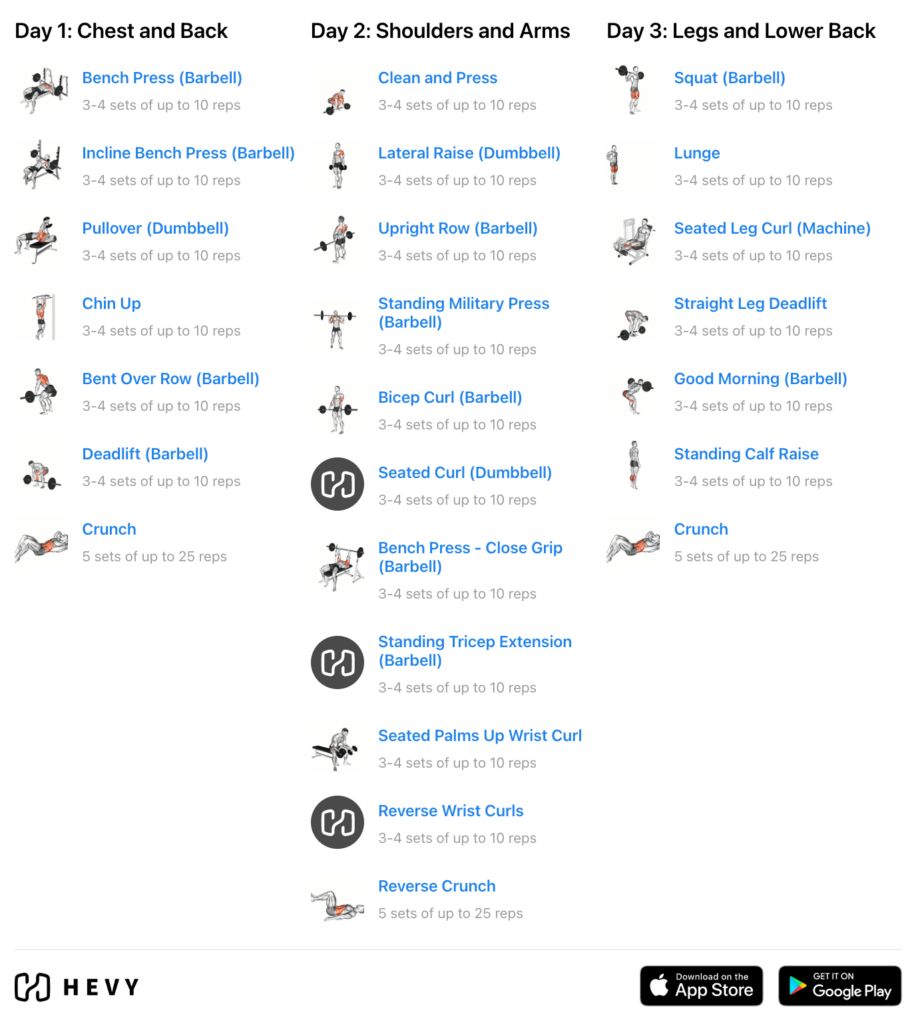
The following is an advanced training split Arnold Schwarzenegger allegedly followed during his pro bodybuilding days.
Level: Advanced
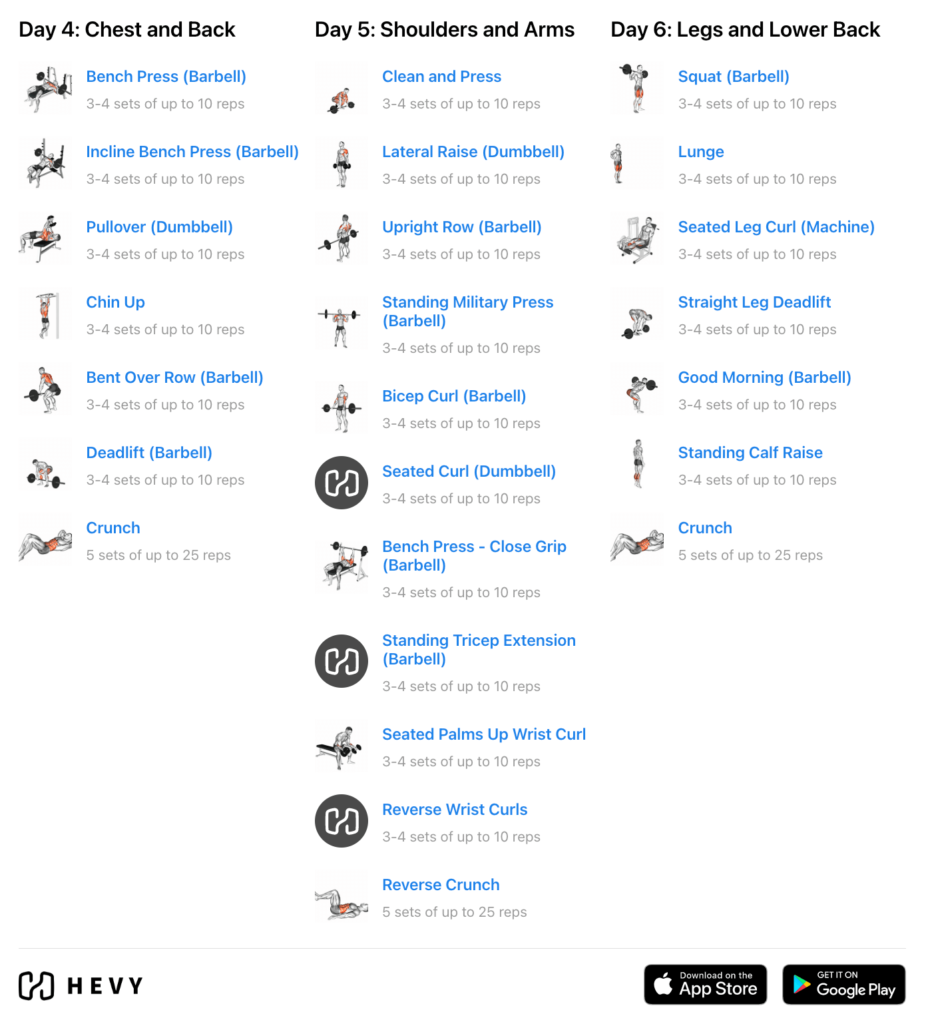
| Day 1: Chest & Back | Day 2: Shoulders & Arms | Day 3: Legs & Lower Back |
| Bench Press 3-4 sets of up to 10 reps Incline Bench Press 3-4 sets of up to 10 reps Dumbbell Pullovers 3-4 sets of up to 10 reps Chin Up 3-4 sets of up to 10 reps Bent Over Row 3-4 sets of up to 10 reps Deadlift 3-4 sets of up to 10 reps Crunches 5 sets of up to 25 reps | Barbell Clean and Press 3-4 sets of up to 10 reps Dumbbell Lateral Raise 3-4 sets of up to 10 reps Upright Row 3-4 sets of up to 10 reps Military Press 3-4 sets of up to 10 reps Standing Barbell Curl 3-4 sets of up to 10 reps Seated Dumbbell Curl 3-4 sets of up to 10 reps Close Grip Bench Press 3-4 sets of up to 10 reps Standing Barbell Tricep Extension 3-4 sets of up to 10 reps Wrist Curls 3-4 sets of up to 10 reps Reverse Wrist Curls 3-4 sets of up to 10 reps Reverse Crunch 5 sets of up to 25 reps | Squat 3-4 sets of up to 10 reps Lunge 3-4 sets of up to 10 reps Leg Curl 3-4 sets of up to 10 reps Stiff Leg Deadlift 3-4 sets of up to 10 reps Good Mornings 3-4 sets of up to 10 reps Standing Calf Raise 3-4 sets of up to 10 reps Crunches 5 sets of up to 25 reps |
| Day 4: Chest and Back | Day 5: Shoulders and Arms | Day 6: Legs and Lower Back |
| Bench Press 3-4 sets of up to 10 reps Incline Bench Press 3-4 sets of up to 10 reps Dumbbell Pullovers 3-4 sets of up to 10 reps Chin Up 3-4 sets of up to 10 reps Bent Over Row 3-4 sets of up to 10 reps Deadlift 3-4 sets of up to 10 reps Crunches 5 sets of up to 25 reps | Barbell Clean and Press 3-4 sets of up to 10 reps Dumbbell Lateral Raise 3-4 sets of up to 10 reps Upright Row 3-4 sets of up to 10 reps Military Press 3-4 sets of up to 10 reps Standing Barbell Curl 3-4 sets of up to 10 reps Seated Dumbbell Curl 3-4 sets of up to 10 reps Close Grip Bench Press 3-4 sets of up to 10 reps Standing Barbell Tricep Extension 3-4 sets of up to 10 reps Wrist Curls 3-4 sets of up to 10 reps Reverse Wrist Curls 3-4 sets of up to 10 reps Reverse Crunch 5 sets of up to 25 reps | Squat 3-4 sets of up to 10 reps Lunge 3-4 sets of up to 10 reps Leg Curl 3-4 sets of up to 10 reps Stiff Leg Deadlift 3-4 sets of up to 10 reps Good Mornings 3-4 sets of up to 10 reps Standing Calf Raise 3-4 sets of up to 10 reps Crunches 5 sets of up to 25 reps |
Modifications
Arnold’s advanced split is incredibly demanding but also flexible. You can tweak almost everything about it, apart from the weekly training schedule.
First, you can swap movements to fit your needs, abilities, and available equipment. For example, Arnold was a big fan of the wide-grip bench press, but you can do a narrow-grip or dumbbell press if a wider grip bothers your shoulders.
Another example is chin-ups, a fantastic exercise for back growth. If you don’t have the strength, you can swap it for band-assisted chin-ups, lat pulldowns, or another pull exercise.
One advantage of using Hevy to log workouts is that you can adjust training details while you work out. You can add/remove exercises and sets, adjust the rest timer, rearrange movements, pair exercises into supersets, mark sets by type, and more. Learn about these and other programming options here.
Schedule
Monday – Chest & Back
Tuesday – Shoulders & Arms
Wednesday – Legs & Lower Back
Thursday – Chest & Back
Friday – Shoulders & Arms
Saturday – Legs & Lower Back
Sunday – Off (Rest day)
6-Day Upper/Lower Split
A 6-day upper/lower split is one in which you perform three upper-body and three lower-body workouts.
Level: Advanced
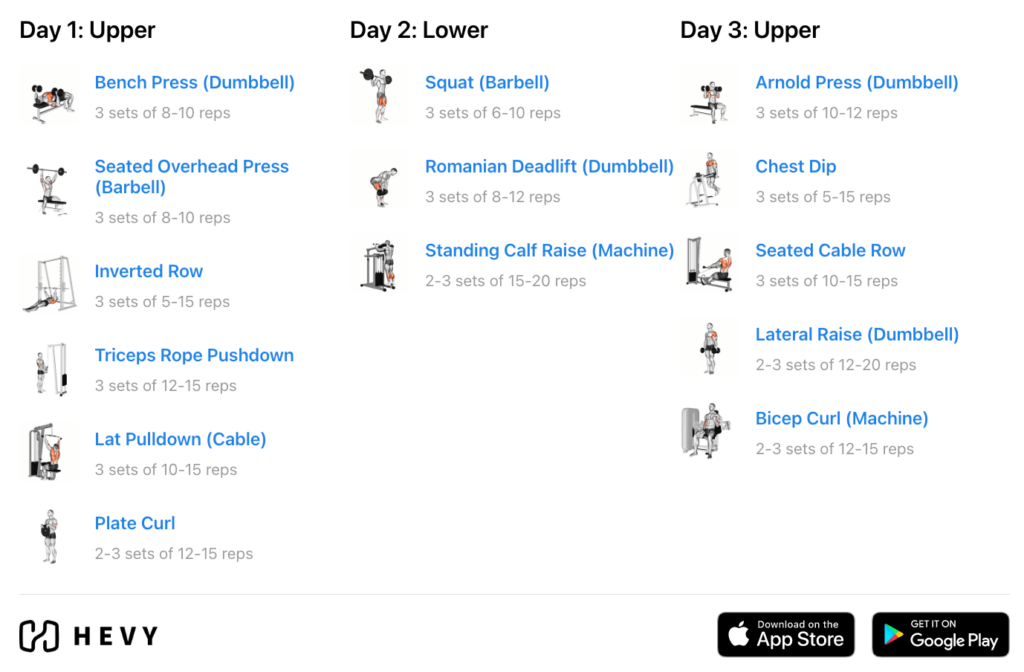
| Day 1: Upper 1 | Day 2: Lower 1 | Day 3: Upper 2 |
| Bench Press (Dumbbell) 3 sets of 8 to 10 reps Seated Overhead Press (Barbell) 3 sets of 8 to 10 reps Inverted Row 3 sets of 5 to 15 reps Triceps Rope Pushdown 3 sets of 12 to 15 reps Lat Pulldown (Cable) 3 sets of 10 to 15 reps Plate Curl 2-3 sets of 12 to 15 reps | Squat (Barbell) 3 sets of 6 to 10 reps Romanian Deadlift (Dumbbell) 3 sets of 8 to 12 reps Standing Calf Raise (Machine) 2-3 sets of 15 to 20 reps | Arnold Press (Dumbbell) 3 sets of 10 to 12 reps Chest Dip 3 sets of 5 to 15 reps Seated Cable Row 3 sets of 10 to 15 reps Lateral Raise (Dumbbell) 2-3 sets of 12 to 20 reps Bicep Curl (Machine) 2-3 sets of 12 to 15 reps |
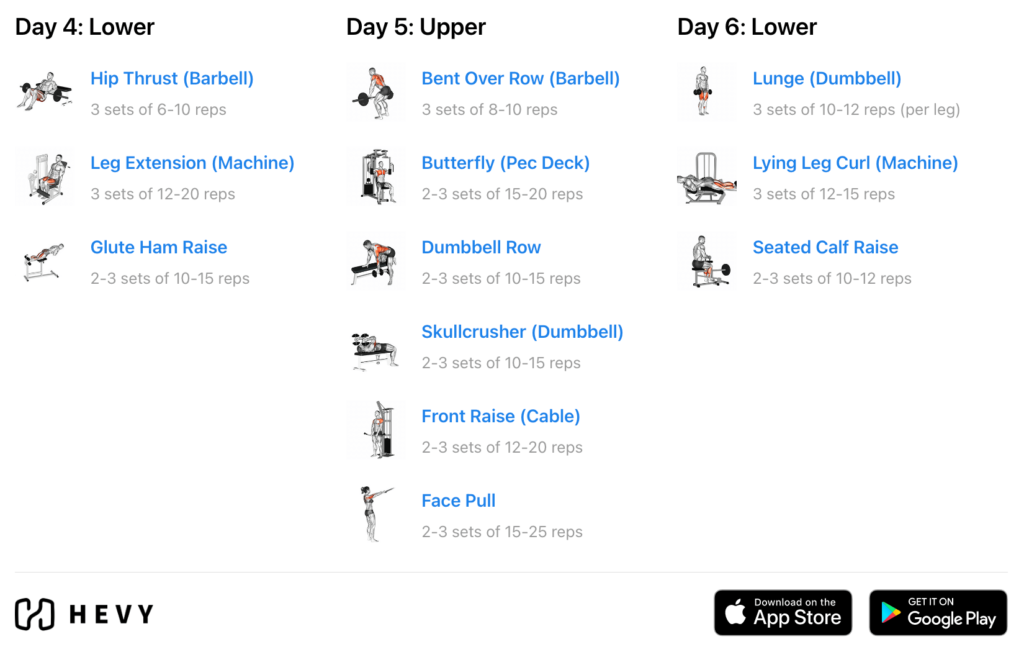
| Day 4: Lower 2 | Day 5: Upper 3 | Day 6: Lower 3 |
| Hip Thrust (Barbell) 3 sets of 6 to 10 reps Leg Extension (Machine) 3 sets of 12 to 20 reps Glute Ham Raise 2-3 sets of 10 to 15 reps | Bent Over Row (Barbell) 3 sets of 8 to 10 reps Butterfly (Pec Deck) 2-3 sets of 15 to 20 reps Dumbbell Row 2-3 sets of 10 to 15 reps Skullcrusher (Dumbbell) 2-3 sets of 10 to 15 reps Front Raise (Cable) 2-3 sets of 12 to 20 reps Face Pull 2-3 sets of 15 to 25 reps | Lunge (Dumbbell) 3 sets of 10 to 12 reps (per leg) Lying Leg Curl (Machine) 3 sets of 12 to 15 reps Seated Calf Raise 2-3 sets of 10 to 12 reps |
Modifications
Modifying your weekly training schedule on a 6-day upper/lower split is impossible. Your only real option is to transition to an 8-day split, similar to the push/pull/legs split. Doing so would give you an extra recovery day. For instance:
Monday – Upper
Tuesday – Lower
Wednesday – Upper
Thursday – Off
Friday – Lower
Saturday – Upper
Sunday – Lower
Monday – Off
The above is an 8-day training block with two recovery days.
You can also adjust your training volume and consider doing fewer exercises per workout, especially if you struggle with recovery (performance stalls, excessive soreness, and so on).
For example, here is how you can modify the first upper workout from above:
| From: | To: |
| Bench Press (Dumbbell) 3 sets of 8 to 10 reps | Bench Press (Dumbbell) 3 sets of 8 to 10 reps |
| Seated Overhead Press (Barbell) 3 sets of 8 to 10 reps | Seated Overhead Press (Barbell) 3 sets of 8 to 10 reps |
| Inverted Row 3 sets of 5 to 15 reps | Inverted Row 3 sets of 5 to 15 reps |
| Triceps Rope Pushdown 3 sets of 12 to 15 reps | Lat Pulldown (Cable) 3 sets of 10 to 15 reps |
| Lat Pulldown (Cable) 3 sets of 10 to 15 reps | |
| Plate Curl 2-3 sets of 12 to 15 reps |
Schedule
Monday – Upper
Tuesday – Lower
Wednesday – Upper
Thursday – Lower
Friday – Upper
Saturday – Lower
Sunday – Off (Rest day)
Download Hevy to find or create your 6-day upper/lower split, and log your first workout today.
6-Day Bro Split
Lastly, we have a 6-day bro split for muscle gain. Here, you get a dedicated session for one or two muscle groups (e.g., chest day, back day, arm day, and so on), and you train all body parts directly once per week.
While it’s largely accepted that training each muscle two to three times weekly leads to more growth (as would be the case on a push/pull/legs or upper/lower split), there’s also an argument to be made for this old-school approach:
- Doing more sets per muscle group in one session could help improve the mind-muscle connection and allow you to target the area you want to develop more effectively.
- While some research finds that higher frequency is more beneficial for growth, other data suggests that total training volume matters most. For instance, a 2019 paper by Schoenfeld and colleagues concluded:
“..there is strong evidence that resistance training frequency does not significantly or meaningfully impact muscle hypertrophy when volume is equated. Thus, for a given training volume, individuals can choose a weekly frequency per muscle groups based on personal preference.” - Some people simply enjoy this schedule more than other options because it helps them exhaust each muscle, get a better pump, and feel like they’ve done good work.
Level: Advanced
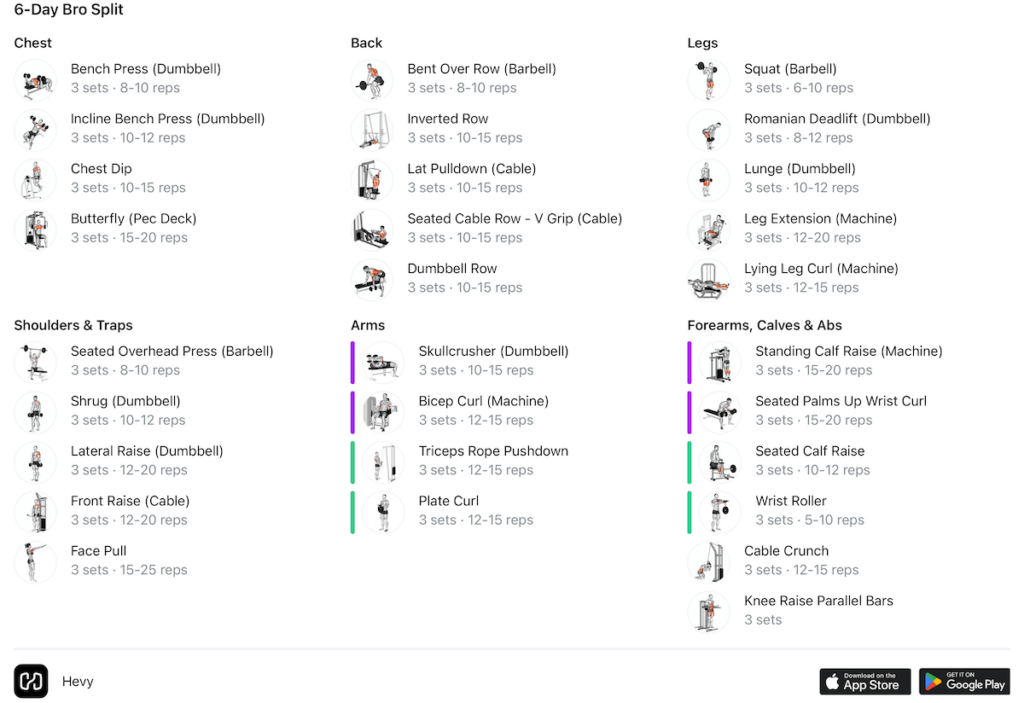
| Day 1: Chest | Day 2: Back | Day 3: Legs |
| Bench Press (Dumbbell) – 3 sets of 8 to 10 reps Incline Bench Press (Dumbbell) – 3 sets of 10 to 12 reps Chest Dip – 3 sets of 10 to 15 reps Butterfly (Pec Deck) – 2-3 sets of 15 to 20 reps | Bent Over Row (Barbell) – 3 sets of 8 to 10 reps Inverted Row – 3 sets of 10 to 15 reps Lat Pulldown (Cable) – 3 sets of 10 to 15 reps Seated Cable Row – 3 sets of 10 to 15 reps Dumbbell Row – 2-3 sets of 10 to 15 reps (per side) | Squat (Barbell) – 3 sets of 6 to 10 reps Romanian Deadlift (Dumbbell) – 3 sets of 8 to 12 reps Lunge (Dumbbell) – 3 sets of 10 to 12 reps (per leg) Leg Extension (Machine) – 3 sets of 12 to 20 reps Lying Leg Curl (Machine) -3 sets of 12 to 15 reps |
| Day 4: Shoulders & Traps | Day 5: Arms | Day 6: Forearms, Calves & Abs |
| Seated Overhead Press (Barbell) – 3 sets of 8 to 10 reps Shrug (Dumbbell) – 3 sets of 10 to 12 reps Lateral Raise (Dumbbell) – 2-3 sets of 12 to 20 reps Front Raise (Cable) – 2-3 sets of 12 to 20 reps Face Pull – 2-3 sets of 15 to 25 reps | Skullcrusher (Dumbbell) – 3 sets of 10 to 15 reps Bicep Curl (Machine) – 3 sets of 12 to 15 reps Triceps Rope Pushdown – 3 sets of 12 to 15 reps Plate Curl – 3 sets of 12 to 15 reps | Standing Calf Raise (Machine) – 3 sets of 15 to 20 reps Seated Palms Up Wrist Curl – 3 sets of 15 to 20 reps Seated Calf Raise – 3 sets of 10 to 12 reps Wrist Roller – 3 sets of 5 to 10 reps Cable Crunch – 3 sets of 12 to 15 reps Knee Raise Parallel Bars – 3 sets to failure |
Schedule
Monday – Chest
Tuesday – Back
Wednesday – Legs
Thursday – Shoulders & Traps
Friday – Arms
Saturday – Forearms, Calves & Abs
Sunday – Off
What is the Best 6-Day Workout Split?
There isn’t a single best 6-day split. Upper/lower, push/pull/legs, and even the Arnold and bro split can work great, so long as you also take good care of your nutrition and recovery. The tricky part of a 6-day split is staying consistent: you only get one day off from working out, and you need to recover well so you can create the progressive overload needed to continue building strength and muscle.
So, the truth is that it’s up to you to decide how to organize your weekly training. We are partial to the push/pull/legs and upper/lower splits, but you can also go with a bro split if you want to switch up your training.
Is the 6-Day Workout Split An Effective Workout?
A 6-day split can be effective if you set it up correctly. It’s easy to train all major muscle groups two to three times per week, you can accumulate the necessary training volume for optimal growth without spending over an hour at the gym each time, and each workout is less demanding (3).
You also experience less significant muscle soreness because you’re training your muscles more frequently.
On top of that, working out six times per week means you can practice the core lifts (squats, bench press, deadlift, etc.) more frequently, leading to quicker and more predictable strength gains (2).
For instance, you can squat, bench press, and deadlift twice a week, starting each workout with one of these movements. You can pair these core lifts with assistance and isolation exercises and complete them in 40 to 45 minutes.

That said, while there are some advantages, ask yourself:
- Can I genuinely train six days every week? You might be motivated now, but would you be able to work out basically every day? Life tends to catch up with us and ruin gym momentum.
- Am I experienced enough? Beginners are often eager to jump into a demanding workout plan that promises fast results. The problem is that six weekly workouts can be physically and mentally draining, especially if you’re not used to high-frequency training.
If you’re not as experienced, start with a lower-frequency split, such as a 3-day one, work your way up to a 4-day split, and then experiment with a 5-day split.
The 6-day approach is also best used during bulking periods, when you eat more calories than you burn to gain weight and increase your muscle mass. Hitting the gym six times while dieting to lose fat will quickly lead to recovery issues. Plus, you don’t need that much training volume to maintain your muscle, and a simple upper/lower split would be enough.
What Are the 6-Day Workout Split Pros and Cons?
Pros
- You can train all major muscle groups twice a week, as recommended (1). Regardless of your approach, working out 6 times provides plenty of opportunities to adequately stimulate your muscles and promote growth.
- You can do plenty of exercises and sets without spending much time in the gym per session.
- Having six weekly workouts means each one is less demanding. For instance, people who can only commit to three weekly workouts must do more sets and exercises per session. In contrast, people who train six days a week do enough sets within 40 to 60 minutes.
- A 6-day split works great for strength gains. You have more opportunities to train primary lifts, such as the bench press and squat, and you don’t have to push yourself as hard in each session (2).
- You can schedule a 6-day split by leveraging the principles behind push/pull/legs, upper/lower, bro (body part) splits, and PHUL
Cons
- Committing to six weekly workouts can turn into a considerable burden, and not everyone has the discipline or time to hit the gym daily
- Working out six days per week might not be sustainable for people with busy schedules and those who often travel for work
- Training six times per week means you only get one recovery day, making you more likely to burn out or become overtrained
- Your programming must be tight to ensure good recovery
- You’re more likely to get injured down the line simply because you’re placing more stress on your joints and connective tissues
- Peaking (gradually increasing intensity to ensure optimal performance on a specific day) and tapering (lowering training volumes before competitions) are more challenging to pull off when training six days per week
Proper Recovery On a 6-day Split

While most people focus on training, proper recovery is just as important for muscle growth. Training stresses your muscles, joints, bones, connective tissues, and central nervous system. However, with time to recover, your body adapts to the stress and becomes stronger.
The most practical way to improve recovery is to include rest days between workouts. For instance, when following a 5×5 program, you train three times per week and have four recovery days. An issue with 6-day splits is that you have only one recovery day for every six workouts, which makes you more likely to experience recovery issues.
Since having more rest days isn’t an option on a 6-day split, another helpful tactic would be to have shorter workouts.
For instance, if your workouts last around 75 minutes when you train four times a week, you can add them up and divide by 6 to determine how long each workout should be on a 6-day split.
75 * 4 = 300 minutes (five hours)
300 minutes / 6 = 50 minutes per session on a 6-day split
You would work out more frequently while keeping your overall training duration the same. Learn more about workout duration here.
Additionally:
- Be in a calorie surplus – eat more calories than you burn, aiming for steady weight gain each month. Doing so is essential for providing your body with the energy it needs for optimal recovery (4).
- Eat enough protein – aim for 0.7 to 1 gram of protein per pound of body weight (5). The nutrient supplies your body with the building blocks (amino acids) it needs to repair and grow muscle.
- Sleep – get at least seven hours of sleep per night to promote muscle protein synthesis, maintain good health, and recover better after demanding workouts (6).
- Calorie surplus – eat more calories than you burn, aiming for steady weight gain each month. Doing so is essential for providing your body with the energy it needs for optimal recovery (4).
- Protein intake – consume 0.7 to 1 grams of protein per pound of body weight (5). The nutrient supplies your body with the building blocks (amino acids) it needs to repair muscle and develop individual muscle fibers.
- Sleep – get at least seven hours of sleep per night to promote muscle protein synthesis, maintain good health, and recover better after demanding workouts (6).
- Limit workout duration – avoid doing incredibly long workouts, especially when you start doing a 6-day split. Keep the workout length in check by following our instructions above.
Workout recovery on a 6-day split can be tricky, and the approach is certainly not for everyone. Our tactics from above will put you in the best possible position for high-frequency training, good recovery, and steady progress.
Combining Muscle Groups for the 6-Day Split
An advantage of 6-day splits is that you can program your training in various ways and combine synergistic muscle groups. One notable example is putting together the chest, shoulders, and triceps in the same workout. These three muscle groups work together on all pressing movements and develop evenly.
The back and biceps are another excellent option for pairing muscle groups. Both contribute during ‘pull’ exercises and develop well as a result. You can do a few back-specific exercises and finish your sessions with bicep isolation movements.
A push/pull/legs workout routine is by no means the only way to program your training, but it closely adheres to the rules of synergistic muscle groups and makes it easy to put together good workouts.
What to Consider When Choosing Your Workout Plan?
Choosing the right workout plan can be challenging. You must consider many variables, take your lifestyle into account, and be honest about what you can sustain in the long run.

Considerations:
- Schedule. You must look at your life and determine what training program you can do. Some people would love to train five or six times per week, but working a full-time job, raising children, traveling for work, and other obligations might get in the way.
- Fitness level. A beginner simply doesn’t need to train six days per week to make optimal progress. Intermediate-level trainees can also benefit from a lower-frequency approach. The only people who should consider a 6-day split are advanced and elite-level trainees.
- Life stress. Stress impacts your recovery, energy levels, and motivation. Adding too much extra tension in the form of a 6-day split can lead to burnout. Be honest and determine if you can handle the significant responsibility.
- Training goals. Do you want to lose fat, build muscle, get stronger, or improve your fitness? A 6-day approach is useful for advanced people who want steady muscle and strength gains.
- Nutrition. Are you currently in a calorie surplus and steadily gaining weight? If not, do you plan to eat more while training 6 days per week?
- Recoverability. How would you rate your overall ability to recover from training? Can you honestly return to the gym day after day, or do you often need a day of recovery after a demanding training session?
“Whether this is realistic or not will largely depend on your discipline, program, training intensity, and ability to recover. You’ll likely want to take note of how many reps you are doing each session, how heavy, or if you’re running, the distance covered.” – Samantha Cubbins, BSc in Sports Coaching Science
There are many training approaches, and you don’t have to follow a 6-day split if you think it isn’t for you. Other fantastic options include the 5×5 program, a bro split, upper/lower, and push/pull/legs.
Conclusion
A 6-day split is one of many training approaches people can use to build muscle, get stronger, and improve their fitness. Like other splits, this one brings some unique benefits and drawbacks.
One notable benefit of 6-day splits is that you can spread your weekly training across more sessions, making each less challenging. One disadvantage is that committing to six weekly workouts can be physically and mentally draining, especially for people not used to structured training. Recovery days are necessary for your body to repair the training-related damage and adapt positively.
Download the Hevy app to access multiple 6-day programs (along with many other workout plans and routines for all levels), log workouts effortlessly, adjust the training variables when necessary, and track your performance on each lift you log.


FAQs
1. Is it okay to have light and difficult workouts on a 6-day split?
Absolutely. Rotating the difficulty can be a great way to recover better, stay consistent, and still get most of the benefits. For example, you can have a couple of sessions (say, the third and sixth ones) where you do less volume, focus more on isolation exercises, or maintain lower RPEs (staying farther from muscle failure).
As Ebenezer Samuel, C.S.C.S., says, “You don’t need seven hard days of training. But there is nothing wrong with lifting something heavy and just being active every single day of your life.”
2. How do I maintain a high quality of my workouts if I train daily?
Start with shorter workouts (30-40 minutes maximum), focus on proper form, rest long enough between sets (1:30-2 minutes on isolation lifts and 2-2:30 minutes on compounds), and listen to your body. Over time, you’ll understand what you can handle without overtraining or going through the motions.
3. What’s a common programming mistake to avoid with a 6-day split?
One of the most common mistakes is making each individual workout too long and difficult. As noted above, each workout should be short and less demanding if you hope to recover on time and train daily.




2 thoughts on “6 Day Workout Split: Programming Options for Optimal Gains (2026)”
Aaaah! What an article!
Hi iwant a beginner 6days …push pull legs alternative days and a mix of more flexibility strength on other days
Mon-legs plus another muscle group
Tue mixed flexibility plus strength
Wed-push
Thurs-mix
Fri-pull
Sat-mix
What all exercises i should add as it’s twice a week i am gonna hit muscles groups is it good to do all different exercises